

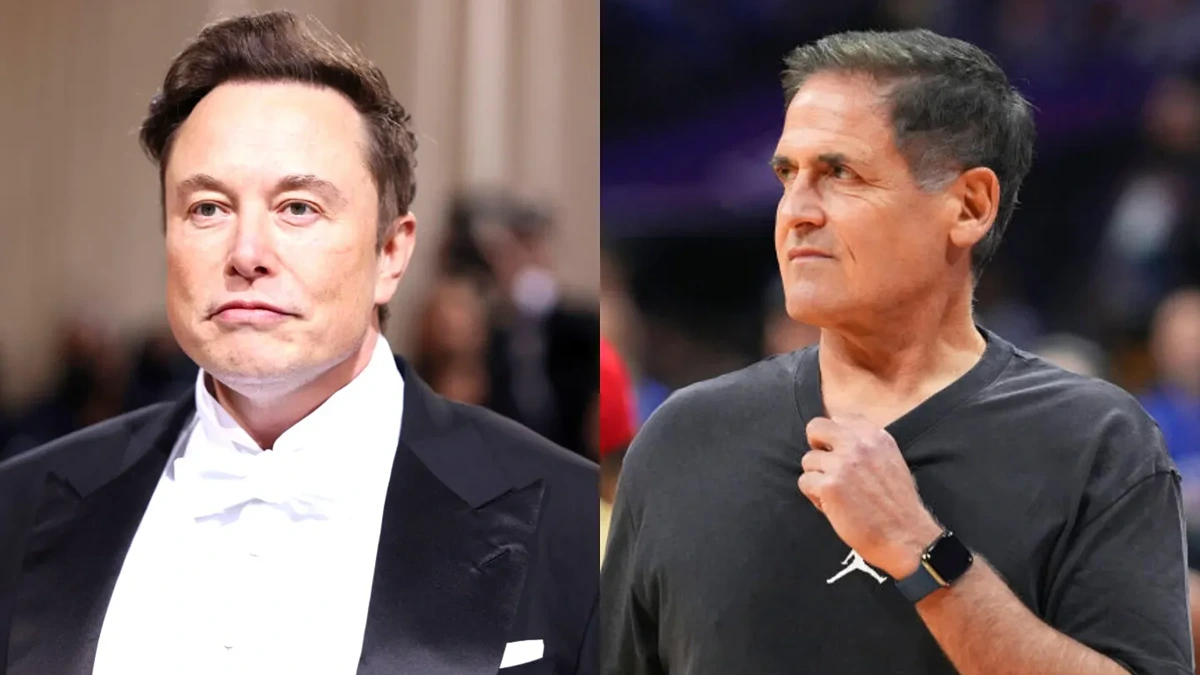
One of the hottest debates was reignited by two of the world’s greatest tech entrepreneurs in late December 2025. This debate is about how society should react to the economic changes and shifts driven by robotics and artificial intelligence.
The billionaire Shark Tank investor and entrepreneur, Mark Cuban, became a part of an urgent conversation about taxes on robots. Elon Musk, CEO of Tesla, brings an optimistic point of view that could transform the economy in the upcoming years.
The clash between the perspectives of two tech entrepreneurs showcases how leaders and entrepreneurs envision the future of productivity, work, and social stake. To grasp the stakes, let’s dive deeper into the broader context of the policy on robot taxation and why this matters.
AI and Economic Growth: Elon Musk’s View
Elon Musk has been one of the most prominent advocates of AI’s transformative potential. In his recent comments on his X account, he reacted to the United States’ GDP data. He suggested that the growth of AI could drive two-digit economic growth over the next 12 to 18 months. Also, it could drive triple-digit economic growth over about 5 years if the productivity gains from AI translate into economic expansion.
Elon’s reasoning stands out as he believes that applied intelligence is a substitute for economic growth. Therefore, using artificial intelligence to improve productivity across the manufacturing industry and logistics services could yield unexpected economic benefits.
Consequently, he believes that the collaboration of AI and robotics is not a technological transformation. Rather, it is a leap that can reduce any previous revolutions in terms of speed and scale.
This viewpoint is based on a long-standing Silicon Valley notion that technological revolution ultimately creates prosperity. Though jobs are lost, new ones emerge, output increases, and living standards rise.
Elon Musk’s perspective is not driven by efficiency; instead, it is about economic dynamism, a space where the capability of machines and human creativity merge to create unimaginable outcomes. However, this raises many questions about who benefits from this, and what will happen to people whose jobs are automated.
Double-digit growth is coming within 12 to 18 months.
If applied intelligence is proxy for economic growth, which it should be, triple-digit is possible in ~5 years.
— Elon Musk (@elonmusk) December 24, 2025
Mark Cuban’s Warning: Wealth Concentration and Social Fallout
Now enters Mark Cuban, one of America’s greatest business professionals and a billionaire Shark. He did not question the growth potential for AI and robotics, but he especially questioned who is to benefit from this growth.
Mark also pressed the leaders and policymakers to prepare for the consequences, rather than react after the shift occurs.
Furthermore, Mark has often highlighted the potential risks of wealth concentration, where the profits from this shift are given to top executives, capital owners, and shareholders. As per his perspective, the broader workforce is left behind.
Cuban’s concerns are not vague or pointless; rather, they are driven by economic history. It shows that inequality increases when productivity gains do not go along with broad-based redistributive policies. Henceforth, he points out that workers laid off by automation may find nothing unless structural policies are in place.
Further, to counter this, Mark backs discussions around robotic tax. It is a tax on the use of automated systems that replace human labor. In particular, he has suggested a direct tax per hour of robot use, regardless of its mechanical form.
He also clarifies that it is not about disturbing innovation. Instead, it is a suggestion to make sure that the rewards of automation are distributed equitably. As a result, society will have the resources to support retraining.
What is a Robot Tax?
Robot tax is not new, though it has gained visibility in recent years with the expansion of AI and automation. A robot tax is levied on organizations that displace human labor with automated machines or systems. Basically, revenue from the robot tax can fund retraining programs, protections, and income schemes.
Nevertheless, other proponents argue that automation replaces human workers and reduces wages across various industries. Without a compensation system or taxation policy, this inequality will increase dramatically over the years. Also, as technological unemployment rises, retraining programs require sustainable revenue sources.
On the other hand, opponents counter that taxes levied on companies can reduce the adoption of innovation, further making automation costly. These taxes can also slow consumer productivity gains and outcomes.
They argued that global innovation has historically increased living standards. This is a universal debate, not confined to any one country. As policymakers from Asia to Europe are stressed on how to tax data and automated labor in a fair manner.
Takeaway
This startling conversation between two tech enthusiasts, Mark Cuban and Elon Musk, is making headlines. It showcases a platform to debate about how will we leverage the power of AI and automation. It also highlights the situation of policymakers across countries, and whether they will let technological growth widen the gap between labor and capital.
One of the tensions across this debate lies in balancing social and economic stability along with innovation. While, without any strategy or thoughtful policy methods it could worsen the social divide.
Mark Cuban has further warned that avoiding these issues might lead to political and national instability. He pointed out that leaders often underestimate political consequences as they are focused on economic returns.