

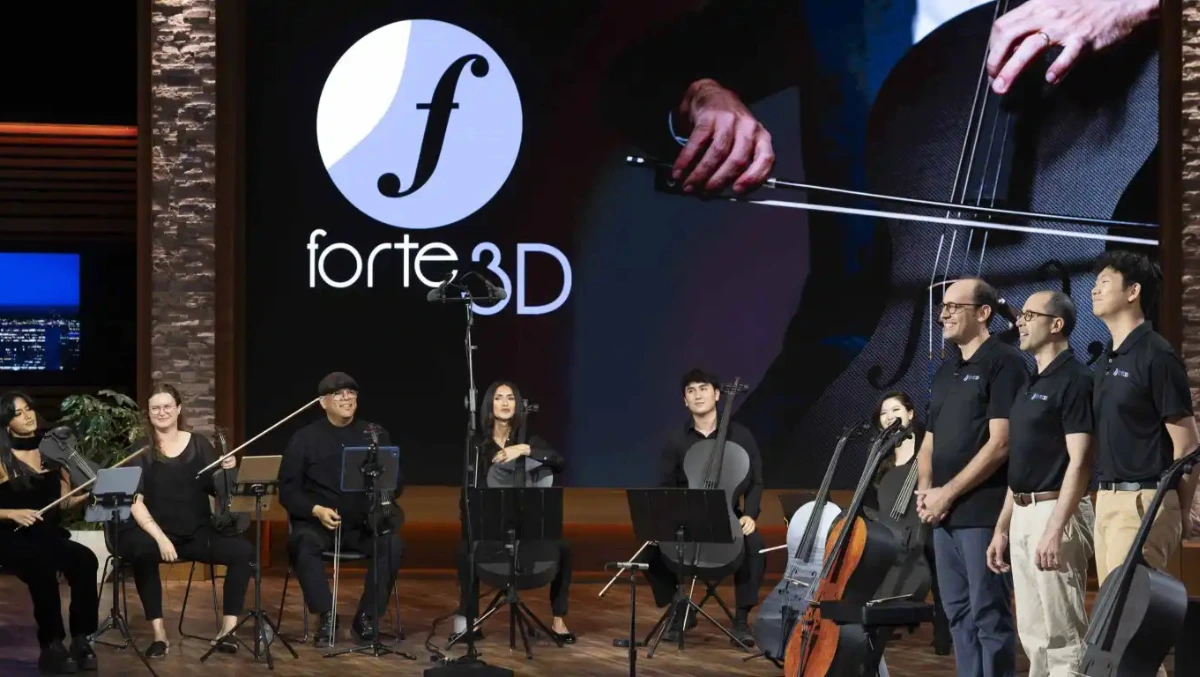
A US-based engineering student has taken a small idea from their high school years and built something much bigger out of it. By leveraging 3D printing and new materials, the student is redesigning the cello. The result blends tradition with modern engineering, as seen on Shark Tank.
Since its appearance on Shark Tank Season 17 Episode 6, Forte 3D has opened up fresh possibilities for how classical instruments are designed or how other stringed musical instruments are built. Elijah Lee is a biomedical engineering senior at Yale who has now taken this work to the Shark Tank stage.
The team built the final cello using 3D printing with carbon fiber and polymer composites.
The 3D Printed Cello From Shark Tank
The product blends ideas from engineering and creative fields, reshaping how makers bring traditional musical instruments to life.
Lee’s cello steps away from traditional tonewood and uses high-performance composite materials. The design keeps the depth and character of the sound fully intact.
The business caught a lot of attention on Shark Tank, and it even reeled in a Shark. The Queen of QVC, Lori Greiner, backed the idea with a $250,000 investment in exchange for 16% equity.
How Forte3D Approached Accessibility and Cost
Lee has commented on his engineering by saying, “The number one skill from Yale Engineering that served me most was the ability to iterate rapidly… To take your best shot, use that information, improve, and try again.”
Lee shared that the idea first took shape in high school. His orchestra director pushed him to combine his interest in music with his curiosity about 3D printing. That small challenge planted the seed for what would later become his innovative cello project.
Partnering with Forte3D CEO Alfred Goodrich, Lee focused on making a cello that could better withstand daily use, remain affordable, and reach a wider audience.
The team rethought everything from the materials to the structure and how the instrument was made. Starting from zero helped them reach the sound and durability they wanted. The result is a streamlined hybrid design built to last longer, cost less, and reach far more players.
Engineering Precision Behind the Acoustics
The team builds the cello by combining modern techniques with traditional craft. They shape the front and back from flat, gently curved carbon-fiber panels, and they produce the ribs and neck using 3D printing. Core sonic components like the sound post, fingerboard, and bridge remain traditional, ensuring the musical authenticity of the instrument.
Forte3D designed its cello for the rough use that musicians actually put their instruments through. It can handle travel, changing climates, and constant playing without compromising sound quality. Much of that reliability comes from how the instrument is designed before it is built.
The team relied on CAD software to refine every part of the design. They tweaked curves, thickness, and materials until the sound felt right. The required level of control simply isn’t possible with hand carved wood, where many of those fine adjustments can’t be tested or repeated.
This design ensures durability without compromising tonal richness, crucial for professional performance.
From First Success to Future Designs
Lee spoke about the first time the cello produced the sound he had been chasing. “That moment made it all worth it,” he said. The company has already released a violin and is now developing 3D-printed versions of the viola and double bass.
Lee and the Forte3D team aim to provide more players with access to high-quality string instruments. It gives people access when high prices or unreliable options shut them out.
By lowering costs and barriers to access, they want music students and working musicians to have tools they might not otherwise reach.
Elijah Lee explained his philosophy by saying, “Music shouldn’t be confined by price or fragile wood. If we can put instruments in the hands of more people, spark curiosity, and make music accessible to everyone, then we’ve really built something that can change the way the world hears music.”
What Forte3D’s Success Means for Musicians
Forte3D’s work shows how curiosity, patience, and problem-solving can reshape even the most traditional spaces. A student project is now reshaping how makers imagine and build string instruments.
Lee and the Forte 3D team are shaking up the instrument industry by offering alternatives that are durable, affordable, and still rewarding to play. The exposure from Shark Tank has further propelled them into the spotlight.
The real impact is yet to be seen. It will arrive when the 3D-printed cello from Shark Tank reaches classrooms, practice rooms, and stages around the world. If Lee and his team succeed, the future of string music may feel a little more open, practical, and welcoming to anyone ready to pick up an instrument.