
McMiller is a sustainable business, a party game that designs high-energy games with no complex rules, and is easy to set up. These games involve physical activity that gets people moving and connecting.
Moreover, it focuses on easy-to-understand, multi-generational, and fast-paced game plays for family and friends get-togethers. So, people of all ages can have fun during parties and game nights.
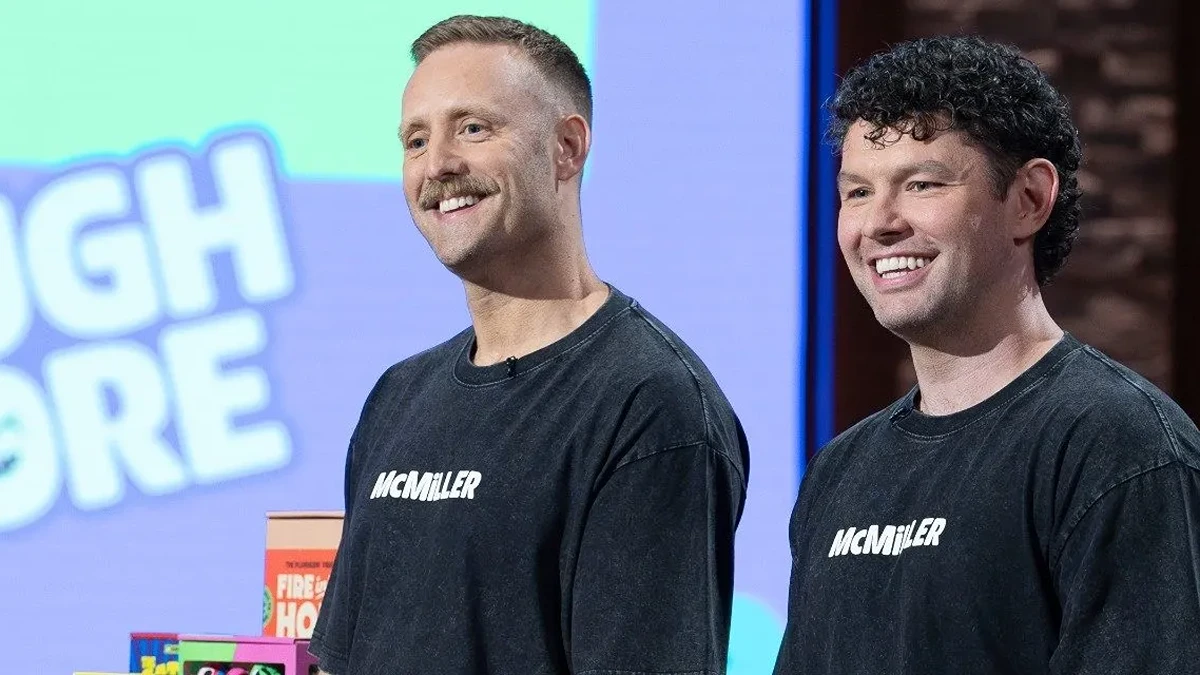
The central mission of McMiller Games is to fill a market gap in modern entertainment. Many board games are either too screen-dependent or too complicated. David McGranaghan and Julian Miller, the founders of McMiller, created interactive games that can bring instant spark to your gathering, party, or game night.
The brand attracted national attention and traction after its appearance on Shark Tank Season 17 Episode 7. McMiller positioned itself as an experiential and inclusive play example in the game industry.
Quick Business Snapshot
| Aspect | Details |
|---|---|
| Company Name | McMiller |
| Industry | Gaming |
| Founding Year | 2017 |
| Founders | David McGranaghan and Julian Miller |
| Product Type | Easy-to-play party games |
| Target Customers | Families, Millennials, Gen Z |
| Business Model | Direct-to-consumer (D2C) |
| Appeared On | Shark Tank Season 17, Episode 7 |
| Deal Status | $200K for 9% stake and 99 cents royalty per product sold |
| Revenue | $5 million in 2025 as per the Shark Tank pitch |
| Current Status | Active |
McMiller Games – Founding Story
David McGranaghan started his journey in the acting industry in 2011 as a professional actor in the Royal Shakespeare Company. Julian Miller took off as a director at No. 33 Productions in January 2010, when they went on a blind date.
Surprisingly, both of them were hustling in the acting industry, but when they put their minds together, their creativity always brought something new to the table.
In one of the recent interviews with People of Play, David talked about how they were asked every time to bring fun to Christmas. Though they were unable to find something that would be liked by all generations, the couple created their own games.
Suddenly, these games became a hit within their family, and that is when the idea to build a company around them hit them.
Consequently, the couple commenced McMiller with its flagship product, It’s Bananas, in 2017 by posting videos on TikTok. Their second viral video of the game blew the roof off by racking up more than 50 million views. Of course, their deep understanding and experience of pacing, humor, and audience engagement helped them with game design.
Unique Features of the Game: It’s Bananas!
They also prioritized fun over complexity. The unique features of their game, It’s Bananas!:
- It’s Bananas!, their signature game, was initially developed as an experiment, instead of a common board game.
- However, the unique concept of players completing silly physical challenges by acting like monkeys gained quick traction at social gatherings.
- Encouraged by this quick growth, the founders started expanding their lineup by introducing Cat Mitt, Fish Fight, Fire in the Hole, and UpRoar.
- Being a planet-friendly company, they manufacture their games using cardboard, cotton, and natural rubber instead of plastic.
- This increased their production cost, but David and Julian chose not to compromise on the quality.
The brand has built viral momentum on different social media platforms, including 500 million organic views, further selling one million units across the globe. As can be seen from their Amazon reviews, how well their It’s Bananas! game worked across different age groups, which made it an award-winning party game.
The Market Problem
The family game market is crowded, and the core problem is that consumers want games that are easy to grasp in under a minute.
Also, the games must work for every age group, including adults, kids, and non-gamers. They want games that do not require apps, and screens that keep everyone engaged. However, traditional board games fail to deliver most of these points.
Who Experiences This Problem
Let’s have a look at who experiences those problems:
Families who are looking for an all-inclusive game for game nights experience this problem as they fail to include everyone in the game. This is also an immense problem for parents who are looking for alternatives to screen-based entertainment.
Also, hosts arranging family get-togethers need fun games for night parties, or during the holiday season.
Why Existing Solutions Fall Short?
Let’s have a closer look at why the existing solution falls short:
- Due to over-complexity, most of the games require trial rounds and long rulebooks to learn.
- The traditional board games have limited replay value, as indoor games like Chess are strategy-heavy and might not interest everyone.
- Digital or app-based games that are reliant on screens reduce the options for face-to-face interactions. Further, in most of the parties, individuals are often busy on their phones, and that raises the need for more interactive games.
- The traditional games are low-energy as they fail to engage active or larger groups of people.
The Market Gap
Undoubtedly, there is an unmet requirement and market for laugh-out-loud-games, that prioritize humor, along with instant participation.
McMiller designs games that feel like shared experiences as they address both the consumer’s want of meaningful screen-free connection, and entertainment fatigue. Hence, they combine performance-style connection with sustainable manufacturing.
Market Opportunity & Industry Context
The worldwide tabletop market showcases a growing and large opportunity, which is driven by demand for screen-free and social experiences.
The industry estimates the party game market to be worth tens of billions of dollars across the globe. It has year-over-year steady growth, fueled by Gen Z, millennials, and families looking for offline interaction.
Industry Trends Supporting Growth
There are several macro trends that are working in favor of McMiller Games.
- Today, consumers, especially parents and millennials, are looking for non-digital games and entertainment alternatives due to screen fatigue.
- These games drive organic growth on social media, with visually engaging short-form content performing well on Instagram and TikTok.
- Today’s consumers and companies are eco-friendly and sustainability-focused, like McMiller’s plastic-free and plant-based games.
Competitive Landscape
The party games market is overcrowded by direct competition from Spin Master, Exploding Kittens, and What Do You Meme titles. On the other hand, there are indirect competitors like board games, traditional casual video games, or mobile party games.
McMiller distinguishes itself from the competitors by emphasizing performance-style play, physical involvement, and an easy-to-learn process. However, other competitors rely on trivia, humor, or digital integration.
Though the bottom line is that the company sits at the center of a growing market, and demand for offline interaction makes it a scalable opportunity.
Early Traction & Pre-Shark Tank Growth
Even before entering the stage of Shark Tank Season 17, McMiller had a significant growth rate, as their lifetime sales were $12.5 million. They projected a net profit of $750K out of $5 million in revenue by the end of the year 2025.
Also, the company has direct-to-consumer sales, along with demand during social and holiday seasons. Before the episode aired, they sold 50,000 units of their flagship game, and the product has the potential for repeat usage.
This signals that it is one of the key indicators of long-term growth and viability. The game, It’s Bananas!, got viral in countries like France, Germany, and Italy. McMiller’s award-winning products have already been featured on media outlets such as BBC, NBC, Kelly and Ryan, FOX, and ITV, earning accolades from Toy Insider.
Consequently, McMiller shows positive customer feedback, including high replay value, easy-to-play, and learning for all age groups. McMiller Games have become crowd pleasers.
Why was Shark Tank a Strategic Move?
McMiller Games’ decision to appear on the Tank was a calculated strategic move, rather than any personal dream or milestone. Before entering the stage, the company had earned significant revenue, validated its product, and built early recognition. Nevertheless, scaling a consumer-goods business is a challenge.
As a consumer-goods company, McMiller requires capital for inventory to meet the seasonal demands, marketing spend to grow beyond organic traction, and for R&D to introduce new formats. Apart from this, operational expansion is also one of the key reasons to seek investment.
Shark Tank Pitch Breakdown
David McGranaghan and Julian Miller stormed the Tank seeking $200,000 in exchange for a 5% stake. All the Sharks were perked up by their unique presentation of It’s Bananas!, in which they asked Kevin O’Leary and Daniel Lubetzky to play this fun monkey game.
Besides that, Sharks like Barbara Corcoran, Daniel Lubetzky, Lori Greiner, and Daymond John were impressed with the strong financials. Also, the high profit margin with a retail price of $23.99 and a manufacturing cost of $3 was one of the key factors that Sharks started offering deals.
Additionally, Kevin O’Leary bowed out of the deal as he stated that the company has just one flagship product, and the rest are all lying as SKUs (Stock Keeping Units). Instead of the associated risks, Barbara Corcoran decided to bet on it by offering $200K for a 9% stake and $2 royalty until she gets her money back.
The interesting twist and the Wow moment happened when the founders told the Sharks that they would get their money back in less than 6 months. That is when David and Julian started receiving offers similar to Barbara’s from Lori Greiner, Daymond John, and Daniel Lubetzky.
However, as there was a head-to-head conversation between the Sharks, Daniel quickly dropped his offer to $200K for 9% equity with 99 cents royalty until he recoups his money. Hence, the deal was locked with the same offer. Let’s have a look at what happened after the Shark Tank appearance.
Post-Shark Tank Business Impact
After the appearance of McMiller on Shark Tank, their visibility and traction increased across the globe. Recently, they have been running a Shark Tank offer on their website, offering a Shark Tank Bundle for $89.99. They are also giving a free shipping option if you spend $30 across the nation.
In the interview with People of Play, the founders mentioned that they are loving the experience, as now they are attending trade shows. They have been to New York, Gama, Nets, and Nuremberg. Being around competitors, retailers, and even inventors is shaping their journey.
They also said to POP that they have met Tami Murphy, who is an ally, and his experience is helping them. Essentially, David mentioned that they will be back at Toy Fair New York in 2026.
What’s Next for Business?
When David and Julian were asked this question, David responded that they were going to build a new slate of games with new mechanics. Julian replied by saying that they are looking forward to more collaborations, partnerships, and trade shows.
Rather than just being a viral game brand, they plan to grow into a major industry player. Now they aren’t looking to create hits; instead, they want to build a line.
Conclusion
McMiller Games positions itself as an experience-first party-game brand, solving a real engagement gap in the tabletop market. By eliminating complexity and emphasizing physical interaction, the company meets growing demand for screen-free social entertainment.