
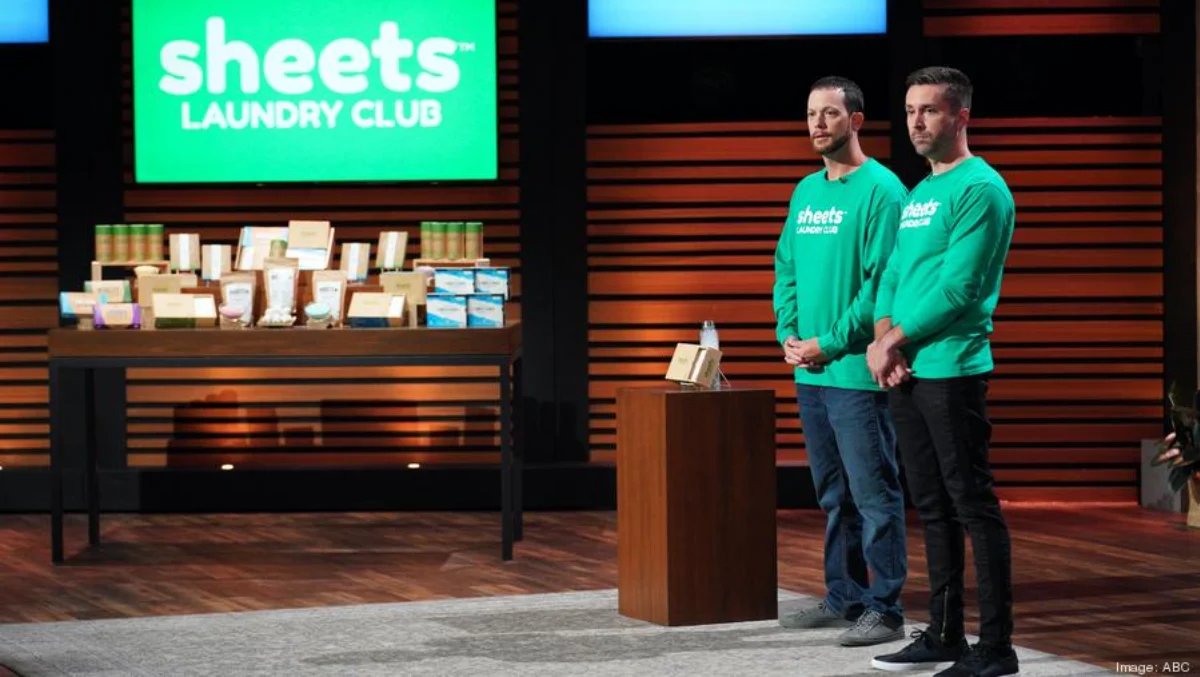
Chris Videau and Chris Campbell walked into the Tank in Season 13 with a simple goal. They wanted to shake up the laundry business with their product called Sheets Laundry Club. They believed in it. But they also knew convincing the Sharks would be a battle.
The battle? Getting a Shark on their side. After all, their product was meant to disrupt a big, pre-established market.
The Case For Detergent Sheets Over Liquid Bottles
The founders’ broader mission was to reduce plastic waste. Traditional detergents come in thick containers that often end up in landfills. Shipping those heavy bottles also burns more fuel.
Instead of buying bulky plastic jugs filled with liquid soap, customers could use slim detergent sheets. Each strip dissolves fully in the washing machine and cleans clothes just like other options in the market.
It is compact. It is cheaper to ship. And it cleans just as well as the liquid or powder most people already buy. Even with those advantages, getting the Sharks to bet on a fresh spin on everyday laundry soap was not simple.
The Story Behind Sheets Laundry Club
The founders went on to talk about what was inside their product. They explained that their sheets leave out the typical heavy chemicals found in many detergents. Instead, they rely on sodium lauryl sulfate derived from coconut oil, something commonly used in shampoos and other personal care items.
Their message was simple. You should not have to bring harsh ingredients into your home just to get your clothes clean.
Midway through the pitch, Barbara Corcoran shifted the focus. She was less interested in the formula and more curious about the people behind it. She asked how they ended up in this business in the first place.
That question opened the door to a personal story. Videau shared that he had served as a U.S. Army Blackhawk pilot. During his deployment in Iraq, he regularly flew over areas where piles of trash burned nonstop in the streets. Breathing in that smoke took a serious toll on his lungs.
He came back to the United States after his deployment with a clear purpose, and cutting down on plastic waste became more than a business idea. It was his way of responding to what he had seen and endured. Launching an eco-focused laundry brand was part of a bigger effort to reduce the kind of environmental damage that had already affected his own health.
Sheets Laundry Club Revenue and Sales Growth After Launch
In total, they were managing 46 SKUs across about 30 different products. The laundry sheets started their business. But the brand had expanded into a broader range of eco-friendly household items.
The company got off the ground in January 2020. Not long after, sales crossed the $2 million mark (at the time of the episode). They also had a 24 percent profit margin to show for it. Plus, they had a short-term patent deal in place with Kimberly-Clark, which added weight to their reputation in the space.
But there was a catch. The royalty agreement tied to that patent was set to expire in 2024 at the time of the pitch. This caught Barbara Corcoran’s attention. She saw it as a risk and questioned whether the founders could properly manage and market so many products at once.
She wondered if they had taken on too much at once. With so many products, she was not convinced they could give each one the attention it needed. She also questioned whether their sales targets were realistic.
The founders did not agree. They said the business was picking up speed and insisted they were on pace to reach $7 million in lifetime revenue. The exchange got tense. You could feel the difference between their belief in the numbers and the Sharks’ doubts.
Sheets Laundry Club’s Shark Tank Deal
Kevin O’Leary was polite but clear when he bowed out. He already had money in Blueland. It was a company built around a similar concept of concentrated, low-waste cleaning products. Investing in another brand chasing the same buyer did not make business sense to him. Ergo, he stepped aside.
Mark Cuban followed with his own reason for passing. He said he was not interested in backing a business that aimed to operate on a global scale. He did not consider global expansion his cup of tea at the moment.
The turning point came with guest shark Daniel Lubetzky. The founders revealed that their subscription program had 21,000 active customers who regularly reordered online. That steady stream of repeat business changed the tone of the conversation. Lubetzky offered $500,000 for 10 percent.
Videau and Campbell were firm about keeping more equity. After some back-and-forth, they struck a deal at $500,000 for 8 percent equity and 2 percent in advisory shares for Lubetzky.
Shark Tank’s Eco Detergent Has Multi-Million Sales
After the episode aired, the momentum did not fade. The company continued to expand its reach. As of 2026, Sheets Laundry Club has over 75,000 customers and is still going strong. Buyers on Amazon and Walmart have shared plenty of positive feedback. Looking back, it seems Barbara Corcoran may have misread this one.