
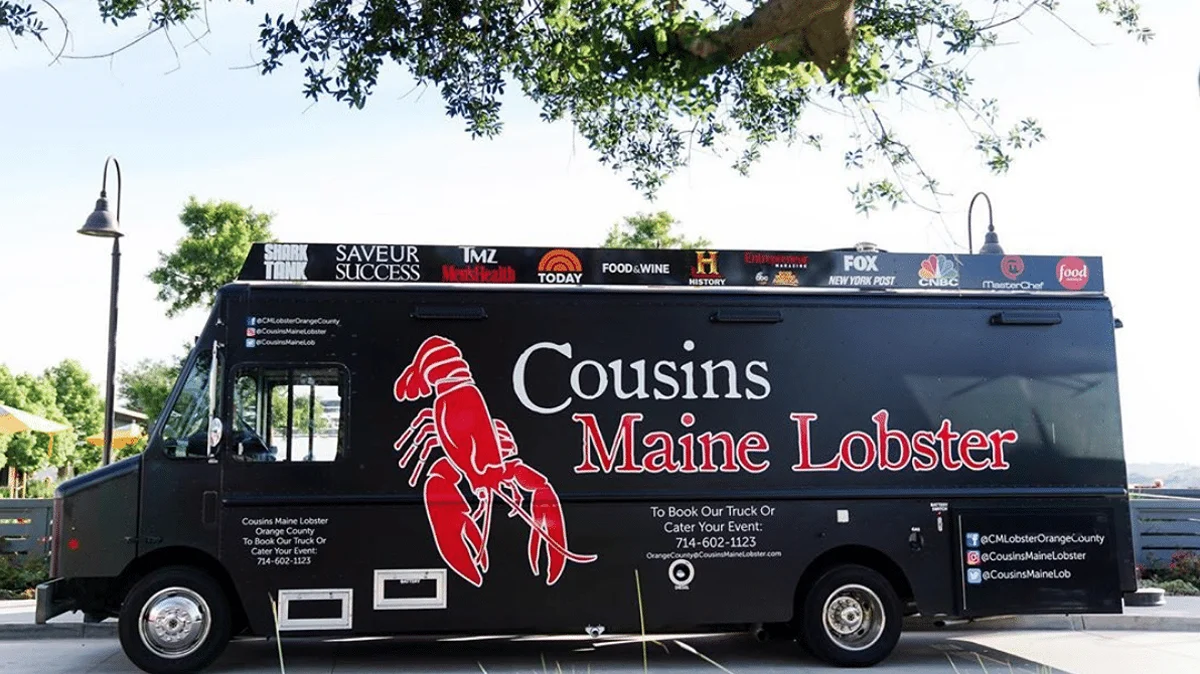
The story of CML began as a humble pitch on the Tank and turned into millions of dollars in revenue, serving hundreds of locations across the nation. Here’s how it all unfolded.
From Maine Roots to a Bold Food-Truck Dream
The story began with a pair of cousins who grew up in Maine, where lobster dinners were a common tradition. When they shifted to LA, the cousins realized that their cultural lobster dinner was almost impossible to find on the West Coast.
In the year 2012, when Cousins Maine Lobster launched, they commenced serving lobster rolls, hitting the streets in April.
The company’s very first year generated a revenue of $890,824 in gross sales from a single truck. Jim Tselikis and Sabin Lomac appeared on Shark Tank Season 4 Episode 6, pitching their lobster rolls.
The Shark Tank Moment: $55K for 15%
The duo of two cousins entered the Tank seeking $55,000 in exchange for a 5% stake in their brand. This further valued the company at $1 million. Their aim was quite simple: they wanted to purchase another food truck so they could expand from one location to another.
The two Sharks, including Kevin O’Leary and Mark Cuban, weren’t impressed with the economics of the business and the overvaluation. Daymond John also shared the same point of view. However, Robert Herjavec and Barbara Corcoran offered two deals. Additionally, their business seemed small and untested.
Barbara Corcoran had an eye for food and hospitality brands, offering $55,000 in exchange for a 17% stake in the brand. After several counteroffers and negotiations, the cousins secured a deal with Barbara of $55K for a 15% stake.
From Local Truck to National Lobster Empire
Apart from the deal at the Tank, Cousins Maine Lobster got publicity, momentum, and credibility, which gave them overnight success. They got nationwide recognition, and demand surged.
In the following year of 2012, the growth was dramatic and significant. As of 2016, Cousins Maine Lobster broadened their reach to 13 locations with 20 food trucks. They commenced their first restaurant in Los Angeles.
They also launched an e-commerce platform that ships live lobsters, lobster meat, and seafood directly to your doorstep. By the year 2017, they reportedly generated revenues of around $20 million. Though the growth did not stop there, CML launched franchises and grew steadily into new states.
The Numbers: From $55K to $585M
In the month of October 2023, many reports stated that Cousins Maine Lobster is among the top 15 most successful Shark Tank businesses. They earned $585 million in their lifetime sales. Their growth in early 2025 had surpassed $1 billion in cumulative nationwide sales.
According to the data from mid-2025, CML reportedly operated over 85 units nationwide. This includes brick-and-mortar restaurants, food trucks, and franchises.
Thus, what started off as a $55,000 investment has supported a business empire generating hundreds of millions in sales.
What Made the Flip So Explosive?
The meteoric rise of CML wasn’t just luck; it was driven by a combination of timing, authenticity, and smart strategy.
- Real Product, Real Demand: Fresh Lobster rolls were a rare food on the West Coast, further highlighting a market gap. The two cousins leveraged nostalgia, authenticity, and quality that many foodies crave.
- Early Proof of Concept and Revenue: Their first food truck in 2012 almost made $900K. This early traction proved that their business model was not just hype.
- Shark Tank’s Platform & Credibility: Furthermore, securing a deal on National television with Barbara bestowed the brand with credibility and visibility.
- Scalable Model: They had a scalable model with food trucks, restaurants, and franchising. Hence, they expanded their reach by multiple food trucks in different regions, shipped lobster rolls to the doorsteps of customers, and adopted a franchise model.
- Consistent Quality and Brand Story: Genuine sourcing of lobster, Maine roots, and emphasis on quality supported the brand in maintaining authenticity, unlike many food chains.
A Lobster Empire And Not Just a Food Truck
Today, Cousins Maine Lobster isn’t just a footnote in Shark Tank lore. They’re a full-blown national brand with dozens of trucks, multiple restaurants, a shipping business, and a growing franchise network.
They brought Maine seafood to neighborhoods across the U.S., from the beaches of California to boardwalks in New Jersey, from the Pacific Northwest to the deep South. Their franchise model continues expanding, with dozens of additional units in development.
The company has shown resilience through challenges, economic downturns, shifting food trends, and even a global pandemic. But they kept innovating. Even as recently as 2025, they’re still opening new units and exploring international expansion.