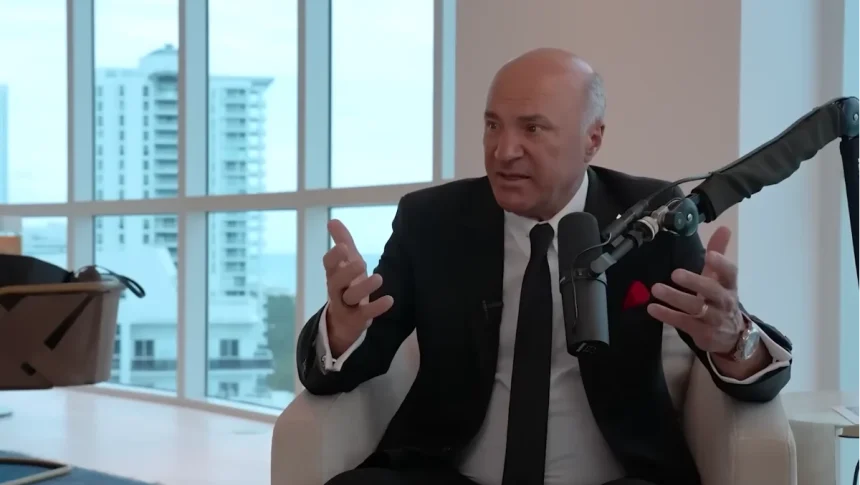
Too often, retirement is framed as a financial milestone. Kevin O’Leary proposes that the true challenge of retirement is not accumulating wealth, but preserving the discipline, independence, and habits that created it.
“Don’t spend it. Save it. Invest it. Let it compound.”
For Kevin O’Leary, the advice is deceptively simple. The entrepreneur and Shark Tank investor has repeated some version of these words for years to audiences, to aspiring investors, and perhaps most frequently, to his own children.
Yet beneath the financial guidance lies something more enduring. Retirement, in O’Leary’s view, is not merely a question of money. It is a reflection of behaviour.
Too often, retirement remains positioned as an endpoint, a number to reach, a date to circle, a finish line waiting at the end of a career. O’Leary pushes back against this framing. His philosophy proposes a future where retirement is not defined by wealth alone, but by preparation itself.
Savings become less about accumulation and more about agency. Investing becomes less about markets and more about patience. This change from financial targets to financial habits is critical.
It places retirement within a broader conversation about personal responsibility, one that recognises discipline not as restriction, but as long-term freedom.
Retirement Is Built Long Before It Begins
It begins long before retirement arrives.
For many workers, retirement planning starts with calculations of how much money is needed, how much should be invested, and when work can finally end.
But for O’Leary, the more important questions emerge much earlier. How do people spend? What habits shape their relationship with money over decades?
The answers often reveal themselves quietly. A credit card balance carried month after month. A savings contribution postponed until next year. Small financial decisions that appear insignificant in isolation but compound over time.
Like many of the lessons O’Leary shares, the solution is rarely dramatic. It is consistency repeated, sometimes unglamorous, and often overlooked.
1. Building Wealth Begins With Everyday Habits
Retirement planning is often shaped by decisions made decades earlier.
One principle sits at the centre of his retirement philosophy: do not retire while carrying debt.
In his writing on retirement, O’Leary argues that financial freedom cannot coexist comfortably with ongoing obligations. Debt may feel manageable during working years, when income arrives regularly. Retirement changes that equation. Paycheques disappear, flexibility narrows, and every financial commitment carries greater weight.
The solution is not always comfortable. Budgets become stricter. Spending becomes more deliberate. Retirement may need to be delayed. Yet for O’Leary, the reward outweighs the sacrifice. A debt-free retirement is not simply a financial achievement. It is a form of independence.
“Don’t retire until you can afford it,” he advises.
Among all forms of debt, high-interest obligations occupy a category of their own.
Credit card balances, in particular, represent something O’Leary repeatedly warns against. Their impact extends beyond the original purchase. Interest compounds quietly, transforming short-term spending into long-term financial pressure.
The advice reflects a larger philosophy. People build wealth not only by earning more but also by avoiding unnecessary losses. Every dollar spent on high-interest payments is a dollar that never reaches a savings account, investment portfolio, or retirement fund.
View this post on Instagram
2. Debt-free Living Creates Flexibility in Retirement
Small financial leaks often become significant burdens over time.
The conversation then expands beyond personal debt and toward retirement income itself.
Many people assume Social Security will provide the foundation for their later years. O’Leary remains cautious about that assumption. Economic uncertainty, demographic shifts, and questions surrounding long-term funding all point toward the same conclusion: relying heavily on a single source of income creates vulnerability.
His perspective reflects a preference for ownership.
The more responsibility individuals assume for their financial future, the less dependent they become on circumstances beyond their control.
This idea appears repeatedly throughout O’Leary’s advice. Wealth is not simply about having money. It is about creating options.
Healthcare introduces another layer to the discussion.
For many workers, medical expenses remain an abstract concern until retirement draws closer. Yet the numbers tell a different story. A relatively healthy life does not necessarily guarantee low healthcare costs later on. Medical expenses accumulate, treatments evolve, and longevity itself creates new financial demands.
O’Leary encourages workers to use their final earning years wisely. Save more. Spend less. Learn to live below current means.
At its core, O’Leary’s philosophy is shaped by consistency, small actions repeated over long periods of time. Saving regularly. Investing steadily. Resisting unnecessary spending. Allowing compound growth to perform its quiet work.
Without consistency, these principles struggle to survive. With it, they become transformative.
Even the act of saving takes on a different meaning within this framework. O’Leary often recommends setting aside at least 15% of income throughout one’s working years. The figure itself is important, but the habit behind it matters even more.
“Telling yourself you’ll save what’s left over rarely works,” his philosophy suggests. Saving comes first. Spending adjusts around it.
This is how discipline becomes a system rather than a temporary decision.
3. Compound Growth Rewards Patience More Than Excitement
Consistency remains one of the most powerful financial tools available.
The entrepreneur’s most enduring lesson may also be his simplest.
In a culture fascinated by windfalls, viral success stories, and overnight fortunes, O’Leary advocates something less exciting but far more dependable. Save. Invest. Repeat.
Lottery wins may happen. Unexpected inheritances may arrive. Market booms may create temporary opportunities. But none of them offer the reliability of consistent behaviour sustained over decades.
The market’s greatest gift, he argues, is compounding and an individual’s greatest responsibility is patience.
Many retirees worry about losing money. O’Leary worries about something else. They lose confidence, flexibility and control over choices that once felt simple.
Debt limits options. Poor planning creates dependency. Overspending reduces freedom.
The opposite is equally true. Savings create security. Preparation creates confidence. Discipline creates independence.
This is the deeper message beneath O’Leary’s retirement advice. The goal is not merely to retire wealthy. It is to retire with autonomy intact.
“The gift the market gives you is compounding,” O’Leary says.
Perhaps the greater gift is what compounding makes possible: the ability to shape one’s future deliberately rather than reactively.
This is how retirement security is built through thousands of small decisions made over a lifetime. Not as a pursuit of more, but as a commitment to enough. Not as a final destination, but as a practice of preparation that begins decades before retirement itself.