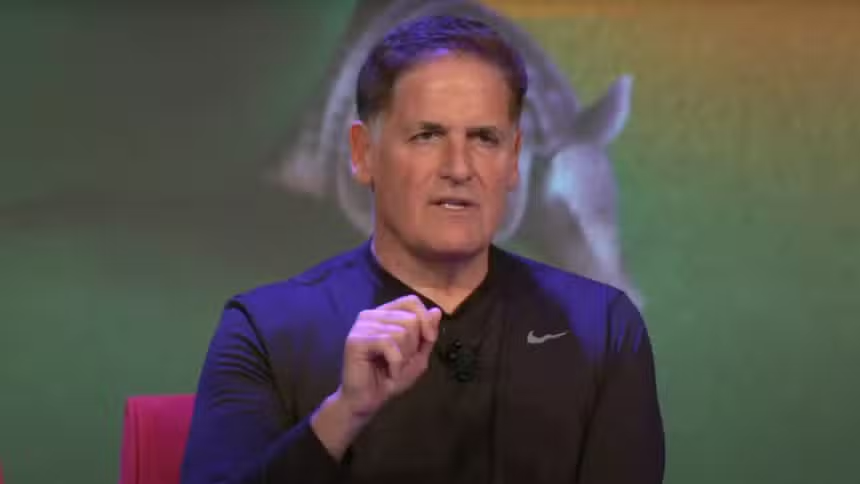
Mark Cuban’s first big purchase after becoming a millionaire was not a mansion, luxury car, or extravagant yacht. Instead, the billionaire entrepreneur spent $125,000 on a lifetime American Airlines flight pass, a decision that still says a lot about how he views money, freedom, and time.
There’s a particular kind of freedom that reveals what people truly value. Not the kind that comes after endless luxury purchases or public displays of wealth, but the quieter freedom that appears when money stops being about survival and starts becoming about choice.
Long before private jets became symbols of billionaire status, Cuban made a purchase that felt oddly practical for someone who had just become rich. After selling MicroSolutions for $6 million in 1990 at the age of 32, one of his first major purchases wasn’t a sprawling estate or a luxury collection.
Instead, he spent $125,000 on American Airlines’ lifetime AAirPass, a first-class travel membership that allowed unlimited flights for life.
At first glance, it sounds extravagant. But the more you sit with the decision, the less it feels like reckless spending and more like a blueprint for intentional living.
The Purchase Was Never Really About Luxury
Mark Cuban has spoken openly about why he bought the pass. “I wanted a lifetime pass on American Airlines so I could go anywhere anytime,” he once explained. He didn’t particularly care about expensive cars or oversized homes. What mattered to him was movement, access, and time.
That distinction changes everything.
Most people imagine wealth through objects. Bigger homes. Flashier watches. Faster cars. But Cuban viewed money differently. He wasn’t trying to collect symbols of success. He was trying to remove friction from his life.
The airline pass gave him exactly that. No hesitation before booking trips. No worrying about costs every time work called him somewhere new. No limitation on mobility.
Strangely, the purchase reflected a philosophy that still defines many successful entrepreneurs today: spend heavily on the things that genuinely improve the way you live and stay indifferent to the things that don’t.
Time, Not Money, Was the Real Currency
What makes the story linger isn’t the six-figure price tag. It’s the reasoning behind it.
“I never, ever thought in terms of money,” Cuban once said in an interview with CNBC. “I always thought in terms of time.”
It’s a perspective that quietly unsettles the traditional idea of financial success. Most people are taught to focus on accumulation first. Save aggressively. Earn more. Build assets. But Cuban’s mindset suggests something more nuanced, that money only becomes meaningful when it changes your relationship with time.
The airline pass wasn’t simply transportation. It was the elimination of barriers. It gave him the flexibility to say yes to opportunities without logistical stress trailing behind every decision.
And perhaps that’s the deeper tension underneath modern spending habits. People often buy things to feel successful, but very few purchases actually create freedom. Many only create maintenance, debt, or temporary excitement.
Cuban’s decision worked because it aligned precisely with the life he already lived.
Spending With Purpose Looks Different for Everyone
There’s a temptation to turn every billionaire habit into universal advice. But the value in Cuban’s story isn’t that everyone should chase unconventional purchases. It’s that meaningful spending is deeply personal.
For someone constantly traveling for business, unlimited flights made sense. For someone else, the equivalent might be investing in a home office, relocating closer to family, hiring help to reclaim time, or paying more for flexibility and peace of mind.
A worthwhile splurge doesn’t necessarily impress other people. In fact, the best ones often look oddly specific from the outside.
That’s what makes Cuban’s purchase interesting decades later. It wasn’t performative. It solved a problem he genuinely had.
In a culture increasingly shaped by curated lifestyles and visible consumption, intentional spending almost feels rebellious.
Cuban has spoken before about how everyday spending habits shape long-term financial freedom, something he explored further in his thoughts on how people approach small daily purchases like coffee.
But Cuban has repeatedly warned against this kind of automatic lifestyle inflation. Wealth, in his view, loses power when every raise immediately expands your expenses.
The Difference Between Access and Value
One of the more subtle lessons hidden inside Cuban’s story is the difference between being able to afford something and actually benefiting from it.
Modern consumer culture confuses the two constantly.
Access creates temptation. A higher salary suddenly introduces possibilities that didn’t exist before. Luxury becomes reachable. Convenience becomes normalized. Spending starts to feel justified simply because it’s possible.
But Cuban’s approach forces a harder question: does this purchase meaningfully improve your life, or does it simply prove that you can buy it?
They are not the same thing.
The airline pass carried value because he used it extensively. Reports over the years suggest Cuban flew millions of miles using the membership, extracting enormous practical value from the original purchase. The cost looked outrageous initially, but over time, the return became obvious.
That framing matters beyond billionaires.
Sometimes the cheapest option creates more stress. Sometimes paying more up front genuinely saves time, energy, or emotional exhaustion later. Other times, expensive purchases quietly become burdens disguised as rewards.
The challenge is learning the difference before the excitement fades.
Why Impulse Spending Rarely Lasts
Something is striking about how calmly Cuban speaks about money despite his enormous wealth. His financial philosophy rarely sounds obsessed with accumulation for its own sake. Instead, there’s usually an undercurrent of practicality beneath it.
That practicality becomes especially clear in how he talks about debt and unnecessary spending.
“If you use a credit card, you don’t want to be rich,” Cuban once said in one of his more widely discussed financial opinions. While the statement sparked debate, the broader point was about intentionality. He has long argued that financial freedom comes from avoiding habits that quietly trap people into endless repayment cycles.
Impulse spending thrives on immediacy. It asks for very little reflection. Excitement arrives first, while consequences arrive later.
Meaningful spending tends to work the opposite way. It survives scrutiny. It still makes sense after the emotional rush disappears.
That’s partly why Cuban’s airline pass remains fascinating decades later. It wasn’t a spontaneous flex rooted in status. Even if the purchase itself happened impulsively during a less-than-sober moment, the logic behind it reflected something enduring about his priorities.
He valued movement. He valued access. He valued time.
And the purchase continued rewarding him accordingly.
A Splurge Should Reflect Your Actual Life
What stands out most about Cuban’s first big purchase is how unapologetically tailored it was to him.
It wasn’t designed for admiration. It wasn’t chosen because billionaires were expected to own one. It reflected the reality of how he worked and what he cared about.
That kind of clarity is surprisingly rare.
People often spend according to aspiration rather than reality. Purchases become attempts to embody a future identity instead of supporting the present one. The result is usually dissatisfaction disguised as ambition.
Cuban’s purchase avoided that trap because it wasn’t trying to manufacture a personality. It amplified an existing lifestyle.
There’s a quiet lesson in that.
The best financial decisions are often the ones that reduce friction between who you are and how you live. Not every expense needs to maximize profit. Sometimes the return comes through freedom, flexibility, convenience, or reduced stress.
But those decisions only work when they emerge from genuine self-awareness instead of social pressure.
Real Lesson Isn’t About the Airline Pass
It would be easy to reduce this story to a quirky billionaire anecdote. A young millionaire buys unlimited flights and ends up using them well. Interesting, but distant from ordinary life.
But the story lingers because it reflects a broader question about money itself: What is wealth actually for?
For Cuban, the answer seemed surprisingly clear. Wealth was useful when it expanded his ability to move through life more freely. Not when it merely looked impressive from the outside.
That idea feels increasingly relevant in a world where spending is often performative and financial success is measured visually. The pressure to appear successful can quietly overpower the desire to live meaningfully.
Cuban’s first major purchase challenges that instinct.
It suggests that the smartest spending decisions are rarely about status. They’re about alignment. They reflect your habits, your priorities, your frustrations, and the shape of the life you genuinely want to build.
Because eventually, every purchase stops being about the object itself.
What remains is the life that is either improved or complicated.