CNN debates rarely stay confined to policy for long. Pressure changes conversations. It strips away the performance first, the polished rhythm of television debate, the rehearsed interruption, the confidence that usually carries a person through a panel segment untouched.
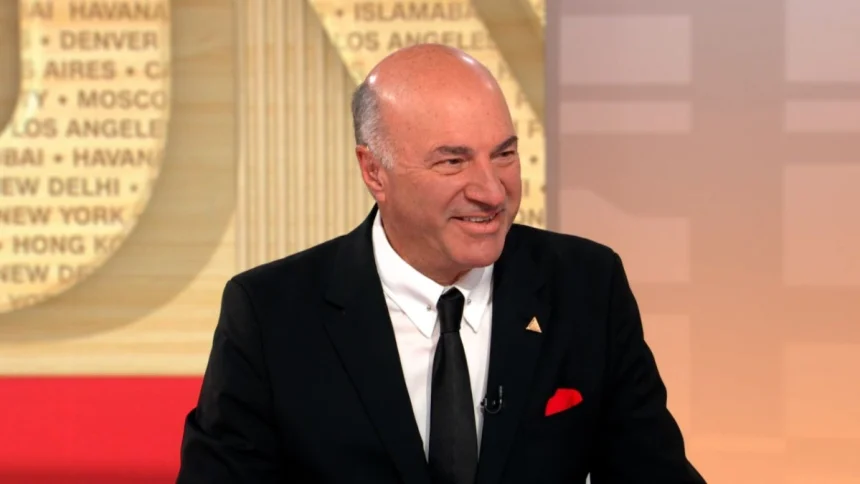
Under enough pressure, something else appears instead: impatience, exhaustion, ego, restraint. On a recent episode of CNN’s NewsNight, Kevin O’Leary found himself at the center of exactly that kind of unraveling.
The moment began as another political discussion, one among many that now pass through cable news with mechanical regularity. The topic was redistricting, following a Supreme Court decision that cleared the way for Alabama to eliminate one of its Black congressional districts.
O’Leary approached the conversation with the same certainty that has long defined his public persona, as blunt, absolute, impatient with complication. But certainty, especially on television, has a way of hardening into provocation.
Across from him sat Bakari Sellers, who was attempting to explain why voting rights debates cannot be separated from the history that shaped them.
Sellers was not speaking abstractly. He was speaking from inheritance, from family memory, from the Civil Rights Movement, from a lineage marked by struggle and survival. The discussion stopped being theoretical long before O’Leary seemed willing to notice.
Bakari Sellers Tried to Add Historical Weight
Sellers referenced Brown v. Board of Education and Plessy v. Ferguson not as historical footnotes, but as living structures whose consequences still shape the present. He spoke about his mother helping to desegregate schools. He spoke about his father being shot during the civil rights movement.
These were not rhetorical flourishes. They were reminders that voting rights in America were not handed over peacefully or equally.
O’Leary, meanwhile, continued interrupting, repeatedly, insistently, and reducing the discussion to constitutional abstraction. “And?” he asked more than once, as though history required further justification before it could be acknowledged.
The interruptions accumulated slowly, then all at once. Pressure works like that. A conversation can appear stable right up until the moment it collapses.
Eventually, Sellers snapped.
“I’m going to finish because you’re being utterly disrespectful,” he said before adding, “Don’t be a d***.”
The sentence landed with the force of exhaustion more than outrage. It was not simply anger at the interruption. It was frustration at having a deeply personal history treated as an inconvenience.
CNN Clash Showed the Limits of TV Debate Personas
For years, O’Leary’s confrontational style has functioned as entertainment. On Shark Tank, his sharp dismissals and brutal honesty became part of the performance that made him famous, reinforcing Kevin O’Leary’s no-nonsense approach.
The boardroom rewards certainty. Television rewards conflict. O’Leary learned to deliver both simultaneously.
But political discussions operate differently, especially when they touch on questions of race, memory, and civil rights. The same qualities that appear decisive in business can feel abrasive in conversations shaped by pain and history. What works as entertainment in one setting can appear deeply out of place in another.
That dissonance became visible in real time on CNN NewsNight. Sellers was attempting to speak about lived experience, while O’Leary remained fixed on the argument. One person was discussing consequences; the other was debating structure. The tension between those two approaches is what gave the exchange its intensity.
Sellers: I’m going to finish because you’re being utterly disrespectful. Don’t be a dick.
O’Leary: I’m not a dick pic.twitter.com/F1IoQYSa1b
— Acyn (@Acyn) May 12, 2026
CNN Viewers Reacted Quickly Online
Television arguments rarely remain confined to television anymore. Within minutes, clips of the debate spread across social media, detached from the broader panel discussion and condensed into a few sharp seconds of confrontation.
CNN viewers reacted strongly, many criticizing O’Leary for appearing dismissive while Sellers discussed civil rights and racial discrimination.
What resonated most was not necessarily the insult itself, but the emotional shift that preceded it. People recognized the moment Sellers stopped trying to remain patient. The clip carried the familiar rhythm of someone realizing they were no longer being heard, only interrupted.
Online reaction moved accordingly. Some defended O’Leary’s style as typical cable-news confrontation, but much of the response focused on tone, specifically, the perception that he treated historical trauma as something to debate rather than understand.
CNN’s NewsNight Has Become a Stage for Escalation
The clash between Sellers and O’Leary did not emerge in isolation. In recent weeks, CNN’s NewsNight has increasingly become a space defined by escalation with raised voices, overlapping arguments, and moments engineered almost accidentally into virality.
Only days earlier, Sellers and O’Leary had already sparred during a discussion about the war in Iran and rising gas prices in America. Sellers questioned what ordinary Americans would realistically gain from the conflict, while O’Leary argued that expanded economic access in the Middle East could eventually benefit American business.
The disagreement revealed the same divide visible in the later debate: one side focused on lived consequence, the other on abstract outcome.
Another recent panel confrontation involving Scott Jennings and Adam Mockler escalated into shouting on air. Increasingly, the programme feels less like a discussion and more like compression, pressure building until someone finally breaks through it.
Why the CNN Moment Stayed With People
What made the exchange linger was not simply its hostility but its familiarity. Many viewers recognized the shape of the conversation immediately. One person attempting to explain why history still matters, another insisting the system has already moved beyond it.
The debate reflected a larger American tension about whether the past is truly past at all.
Sellers approached the discussion through memory, inherited, painful, and unfinished. O’Leary approached it through logic and constitutional principle. Neither framework could fully reach the other. The frustration came from watching those two languages collide without translation.
That collision is what transformed a routine CNN panel into something larger. The argument stopped being about redistricting alone. It became about whose experiences are treated as evidence and whose are treated as interruptions.
The Exchange Revealed More Than Either Man Intended
In the aftermath of the debate, the clip continued circulating not because it resolved anything, but because it exposed something unresolved underneath it. Pressure does that. It forces people into sharper versions of themselves.
For O’Leary, the moment revealed the limits of a persona built on dominance and interruption. For Sellers, it revealed the exhaustion of repeatedly explaining why certain histories still matter. Neither man left the exchange unchanged in the eyes of viewers.
What remained afterward was not the policy discussion itself but the atmosphere surrounding it, the impatience, the collision of perspectives, the refusal to listen long enough for complexity to survive. In that sense, the debate became less about politics than about the conditions under which public conversation now happens at all.