Parrot Finance Shark Tank Update – Shark Tank Season 17
A fintech platform designed to help everyday investors follow the strategies of top professionals. Parrot Finance impressed the Sharks and secured a deal with Lori Greiner and Rashaun Williams.

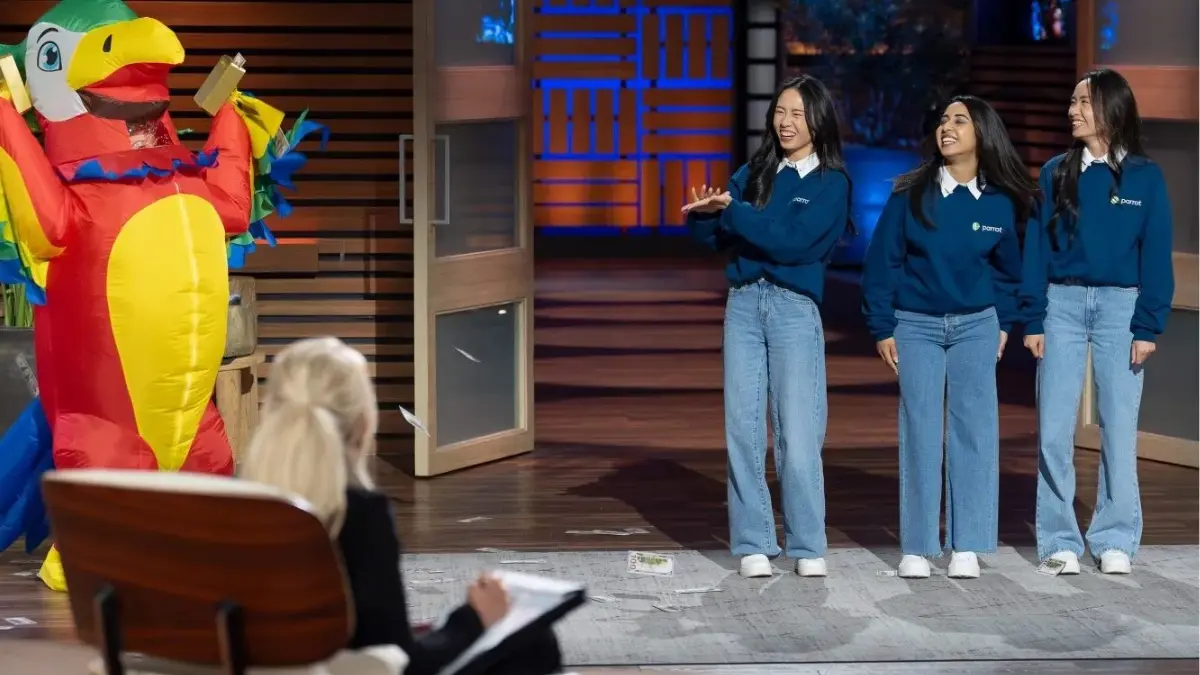
What if you could invest like a hedge fund manager without being one? That’s the bold idea behind Parrot Finance.
Instead of guessing where to put your money, this app lets everyday investors track and replicate strategies based on public disclosures. When Nikki Varanasi, Lucy Yang, and Victoria Yang stepped into Shark Tank Season 17 Episode 18, they didn’t just pitch another fintech app, they introduced a data-driven way to make investing more accessible.
With strong early traction, viral growth, and a compelling concept, the Parrot Finance Shark Tank pitch stood out and sparked one of the most competitive deal discussions of the episode.
About Parrot Finance
| Category | Details |
|---|---|
| Business Name | Parrot Finance |
| Founders | Nikki Varanasi, Lucy Yang & Victoria Yang |
| Industry | Fintech / Investment Platform |
| Product | Portfolio tracking and trade-mirroring platform |
| Funding (Pre-Shark Tank) | Raised ~$2.5M via SAFE note |
| Investment Asked | $250,000 for 2.5% equity |
| Deal Status | Deal secured with Lori Greiner & Rashaun Williams |
| Deal Outcome | $250,000 for 6% equity (4% equity + 2% advisory shares) |
| Valuation | $10 Million |
The founders come from strong financial and technical backgrounds, with experience in hedge funds, investment banking, and engineering. Their goal was to make complex financial data accessible, actionable, and easy to understand for everyday users.
The app was launched just months before Shark Tank but quickly gained traction through social media and organic growth.
Product Overview
Parrot Finance is a fintech app that allows users to track and mimic investment strategies used by hedge funds, CEOs, and even politicians.
The platform works by allowing users to connect their brokerage accounts, browse top-performing portfolios, receive alerts when notable investors make trades, and instantly replicate those trades.
It uses publicly available data, such as 13F filings, and aggregates it into a user-friendly format that simplifies complex financial information. Unlike traditional investing apps, Parrot Finance focuses on “behavior-based investing,” allowing users to follow real investor actions rather than relying only on static advice.
Parrot Finance Shark Tank Pitch
The founders entered the Tank seeking $250,000 for 2.5% equity, implying a $10 million valuation.
They opened with a strong message: access to top investment strategies has historically been limited to the wealthy. Their platform aims to change that by giving retail investors access to the same insights.
As the pitch progressed, Lori Greiner raised concerns about data privacy and sourcing, while Kevin O’Leary questioned whether the model was simply repackaging public data.
The discussion shifted when Rashaun Williams leaned in, recognizing the fintech potential and scalability of the business.
The founders revealed that they had already gained 25,000 users and connected approximately $85 million in assets through the platform. This traction impressed the panel.
However, in terms of revenue, the business was still in early-stage. The founders had recently introduced a subscription model priced between $8 and $15 per month.
While the product impressed, the lack of established revenue became a key sticking point during negotiations.
What Makes Parrot Finance Unique?
The following features set Parrot Finance apart in the fintech space:
- Allows users to mimic real investor trades instead of guessing
- Uses public financial data but presents it in a simplified way
- Combines social investing with actionable alerts
- Built on a subscription-based model rather than commissions
- Focused on accessibility for retail investors
Did Parrot Finance Get a Deal on Shark Tank?
The deal discussion quickly turned competitive.
Rashaun Williams and Lori Greiner teamed up to make an offer of $250,000 for 10% equity, valuing the company at $2.5 million. They emphasized their experience in fintech and ability to help scale the business.
Kevin O’Leary countered with an offer of $250,000 for 7% equity, positioning himself as a strong strategic partner in financial services.
With multiple offers on the table, the negotiation became one of the most dynamic moments of the episode.
The founders pushed back, negotiating for better terms. After some back-and-forth, Lori and Rashaun agreed to a revised structure.
With Kevin still in contention, the founders ultimately chose Lori and Rashaun, closing the deal at $250,000 for 6% (4% equity + 2% advisory shares).
Parrot Finance Shark Tank Update
After its appearance on Shark Tank, Parrot Finance highlights as a startup with strong early traction and significant growth potential.
With thousands of users and millions of connected assets, the platform has demonstrated clear demand. However, it still faces the challenge of converting user growth into consistent revenue.
The fintech space is highly competitive, and scaling while maintaining user trust will be critical for long-term success.
Where Can You Use It?
Parrot Finance is available as a digital platform on its official website that integrates with major brokerage accounts. Users can sign up online and start tracking and mimicking trades directly from their devices.
Follow them on their Instagram and Facebook for more updates.
Quick Summary
- Parrot Finance allows users to mimic the investment strategies of top investors.
- The founders secured a $250K deal with Lori Greiner and Rashaun Williams.
- The platform gained early traction with 25,000 users and $85M in connected assets.
Check out other Shark Tank Season 17 Episodes.
Curious about the other businesses featured in Shark Tank Season 17 Episode 18? Explore all the businesses and deals from this episode to see which ideas made a splash in the Tank.