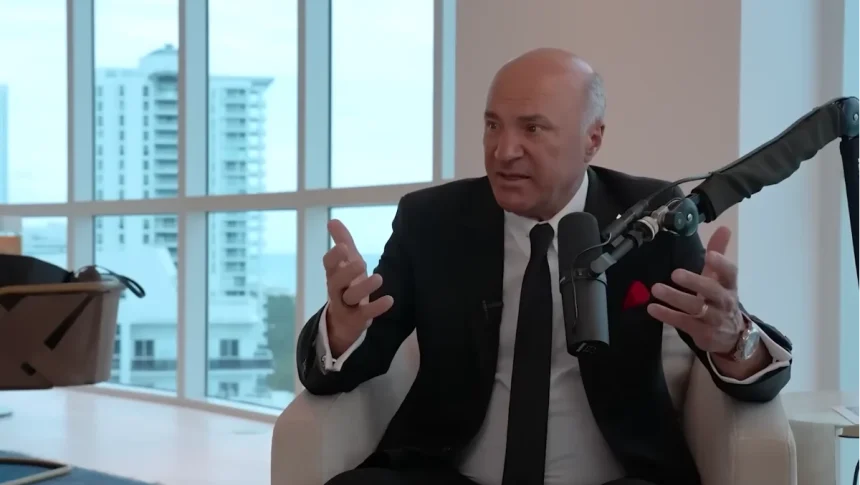
There’s something almost contradictory about the way Kevin O’Leary speaks about money. His public image is sharp, demanding, and occasionally ruthless, yet when he discusses investing, the philosophy underneath is remarkably restrained. No dramatic predictions. No obsession with chasing the next big thing. Just structure, discipline, and a quiet resistance to chaos.
At a time when investing advice is increasingly shaped by viral trends, AI hype, and overnight success stories, O’Leary’s latest portfolio breakdown feels intentionally unglamorous. And perhaps that is precisely the point.
In a recent appearance on The Iced Coffee Hour podcast, O’Leary explained that he currently divides his investments into three broad categories: 60% equities, 20% fixed income, and 20% alternatives.
It is not a complicated formula, nor is it presented as a secret reserved for billionaires. Instead, it reads more like a philosophy of balance, one that values endurance over excitement.
The Quiet Confidence of a 60/20/20 Portfolio
Investment conversations today often sound urgent. Markets are moving quickly, technology is evolving faster than most people can process, and social media has turned financial advice into entertainment. Amid all of that noise, O’Leary’s allocation strategy feels almost calm.
Sixty percent of his portfolio remains invested in equities, spread across global markets rather than concentrated solely in the United States. Twenty percent sits in fixed income assets like bonds, designed to provide stability and predictable income. The remaining twenty percent is allocated to alternative assets such as cryptocurrency, gold, and collectibles.
The structure itself is straightforward, but what makes it interesting is the thinking behind it. Kevin O’Leary is not attempting to eliminate risk entirely. Instead, he appears focused on creating a portfolio that can survive different kinds of economic environments without becoming emotionally exhausting to manage.
Why Stocks Still Hold the Largest Share
Despite frequent warnings about recessions, inflation, and market pullbacks, equities remain the largest piece of O’Leary’s portfolio. That decision reflects a belief many long-term investors still hold: over time, stocks continue to be one of the strongest tools for building wealth.
But his approach is not built around blind optimism. The emphasis on global diversification suggests something more measured. By investing across different economies and sectors, O’Leary reduces the pressure on any single market to perform perfectly.
There is a certain practicality in that idea. Economies rise and slow at different times, industries evolve unpredictably, and geopolitical shifts can reshape markets overnight. Diversification, in this context, becomes less about maximizing gains and more about creating resilience.
Growth Without Obsession
What stands out in O’Leary’s framework is his refusal to treat growth as the only objective. Modern investing culture often celebrates aggressive returns while ignoring the emotional cost of volatility. O’Leary’s allocation seems designed to avoid that imbalance.
The portfolio still leaves room for growth, but it does not demand constant speculation. It acknowledges uncertainty instead of pretending it can be conquered.
The Stabilizing Role of Fixed Income
Twenty percent of O’Leary’s portfolio is allocated to fixed-income investments, including bonds. In periods when stocks become volatile, these assets can offer something markets rarely provide consistently: predictability.
For retirees or investors nearing retirement, that predictability matters. Fixed income investments may not deliver explosive returns, but they can generate steady cash flow and help preserve capital during downturns.
There is also a psychological dimension to this allocation. Investors often underestimate how fear influences decision-making. A portfolio entirely dependent on equities can become emotionally difficult to hold during sharp corrections.
Fixed income acts as a counterweight, softening the emotional swings that frequently lead investors into reactive decisions.
Stability as a Strategy
O’Leary’s emphasis on bonds does not come across as pessimistic. Rather, it suggests an understanding that successful investing is not simply about earning more. It is also about protecting what has already been built.
That distinction becomes increasingly important during uncertain economic periods. Stability, in many ways, is its own form of growth.
Why Alternatives Still Matter
The final 20% of O’Leary’s portfolio is dedicated to alternatives, including gold, crypto, and collectibles. These assets occupy an interesting space in modern investing conversations. They are often either overhyped as revolutionary or dismissed entirely as speculative distractions.
O’Leary’s approach sits somewhere in the middle.
He does not position alternative assets as the foundation of his portfolio, nor does he reject them outright. Instead, they function as another layer of diversification, assets that may behave differently from traditional stocks and bonds during changing market conditions.
Gold, for example, has historically been viewed as a hedge during economic uncertainty. Cryptocurrency, meanwhile, represents exposure to emerging financial systems and technological infrastructure. Collectibles introduce yet another dimension of value, one less directly tied to public markets.
What matters most is the proportion. These investments remain contained within a broader framework rather than dominating it.
Kevin’s Warning About AI Hype
One of the more telling aspects of O’Leary’s recent comments involved artificial intelligence stocks. While he acknowledged the long-term importance of AI, he also warned investors about becoming overly concentrated in trendy sectors.
That caution feels particularly relevant right now. Many AI-related companies have experienced dramatic rises followed by equally sharp pullbacks. O’Leary’s perspective is not anti-innovation; it is anti-overexposure.
Even a relatively small allocation can become risky if it is heavily concentrated in volatile assets. The danger, according to O’Leary’s broader philosophy, lies in assuming that momentum alone guarantees permanence.
The Discipline of Position Sizing
There is a recurring theme throughout O’Leary’s investment framework: discipline matters more than excitement.
The most effective portfolios are often not the loudest ones. They are structured carefully, adjusted thoughtfully, and designed to endure market cycles rather than react emotionally to them.
In that sense, diversification becomes less of a technical investing term and more of a mindset.
The Larger Lesson Behind the Portfolio
What makes O’Leary’s allocation strategy compelling is not merely the numbers themselves. Many investors already understand the basic importance of balancing stocks, bonds, and alternative assets. The real takeaway is the consistency of the philosophy underneath it.
That same emphasis on discipline and long-term thinking also appeared in Kevin O’Leary’s advice on smarter spending habits during economic uncertainty.
Growth and protection are not opposing goals. Risk and stability do not have to exist in separate worlds. A portfolio can pursue opportunities while still respecting uncertainty.
That balance feels increasingly rare in a culture that often treats investing like competition. O’Leary’s approach quietly rejects the idea that every financial decision needs to be dramatic.
And perhaps that is why the framework resonates. It reminds investors that long-term wealth is often built not through constant reinvention, but through patience, structure, and the willingness to stay grounded when markets become difficult to read.
In the end, the simplicity of the 60/20/20 split may be exactly what gives it staying power.