Failure is part of the process of learning, and the value of going through it is often underestimated.
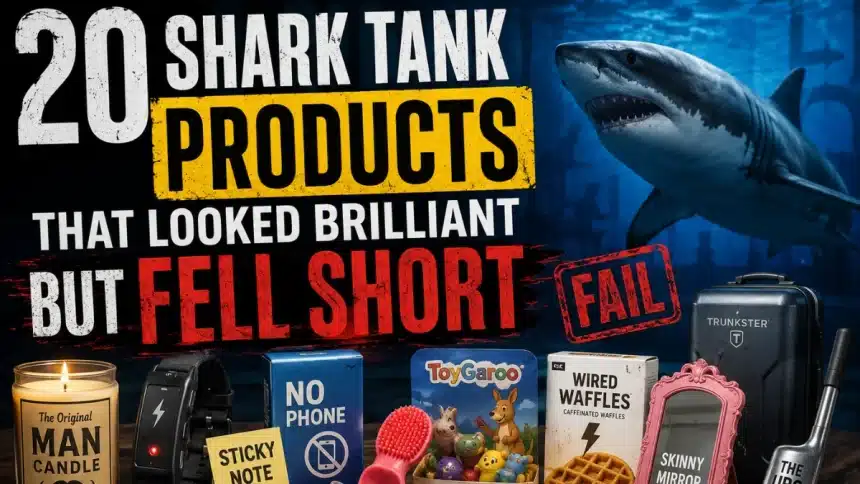
Every season introduces dozens of Shark Tank products that promise to change the way people live, work, and spend. While some become household names, others reveal just how difficult it is to transform a clever idea into a lasting business.
Success stories like Scrub Daddy and Bombas have become part of entrepreneurial folklore, but for every breakout hit, some products struggled with execution, demand, credibility, or practicality.
Innovation is treated as the finish line. Shark Tank treats it as the starting point. The show places products inside a harsher conversation about scalability, pricing, customer behavior, and operational reality. That is why some pitches that sounded clever in the room never became durable businesses outside it.
Why Some Shark Tank Products Never Take Off
The appeal of Shark Tank Products lies in their ability to solve everyday problems in unexpected ways. But innovation alone is rarely enough to guarantee long-term success.
1. Original Man Candle
The Original Man Candle tried to reframe scented candles as a masculine product category, with unusual fragrances including popcorn and flatulence. The pitch was memorable, but the novelty quickly overwhelmed the practicality, and none of the sharks invested.
2. Pavlock
Pavlock promised to help users break bad habits through small electric shocks delivered by a wearable device. Investors questioned both the scientific evidence and the product’s effectiveness, and after the founder rejected Kevin O’Leary’s offer in search of another deal, every shark backed out.
3. Squirrel Boss
Squirrel Boss attempted to protect bird feeders by shocking squirrels. The problem was fundamental: the device could not reliably distinguish squirrels from birds, shocking any animal that touched it. Combined with a high price and no patent protection, the product failed to gain investor support.
4. ToyGaroo
ToyGaroo offered parents a subscription service for renting children’s toys, earning investment from Mark Cuban and Kevin O’Leary. The concept generated demand, but the business could not handle the operational burden of inventory, cleaning, and shipping. The company eventually went bankrupt.
5. Licki Brush
Licki Brush lets cat owners groom their pets using a tongue-shaped brush worn in the mouth. The founder framed it as a way to mimic natural feline bonding behavior, but the demonstration made investors visibly uncomfortable, and no deal emerged.
6. NoPhone
NoPhone addressed smartphone addiction by selling a fake smartphone, essentially a plastic rectangle shaped like a phone. It attracted attention for its satire, but attention did not translate into a compelling business case.
7. Sticky Note
Sticky Note was a computer-mounted pad designed to hold sticky notes near the screen. Sharks questioned the high valuation, the lack of sales, and whether the product solved a meaningful enough problem to justify its price.
8. Fish Frenz
Fish Frenz was a floating bait-release container intended to help anglers attract fish. The pitch was weakened by awkward marketing that suggested special appeal for women, and the founder admitted he had not sold any units. Investors walked away.
9. Copy Keyboard
Copy Keyboard reduced copying and pasting to a dedicated two-button USB device. The simplicity of the product became the problem. Sharks struggled to see defensible differentiation or enough value to justify investment.
10. Cate App
Cate App, designed to hide messages from specific contacts, initially gained user interest and secured funding. Technical problems, security vulnerabilities, and stronger alternatives eventually undermined the product and the investment.
11. Throx Socks
Throx Socks sold socks in packs of three, so customers would have a spare when one sock disappeared. The idea was clever, but investors doubted that consumers would change established buying habits for a problem they mostly tolerated rather than actively solved.
12. Minus Cal Health Bars
Minus Cal promoted bars and tablets with a special extract that supposedly blocked calorie absorption. Investors pressed the founders for scientific evidence, found the claims unconvincing, and became frustrated by conflicting explanations during the pitch.
13. Carsik Bib
Carsik Bib was designed to contain vomit during motion sickness episodes. The founder’s graphic demonstration, complete with fake vomit, made the pitch unforgettable for the wrong reasons. No shark invested, and the company later ceased operations.
14. Nootrobox
Nootrobox offered caffeine-infused cubes and cognitive supplements positioned as productivity enhancers. Sharks challenged the scientific claims, the large valuation, and a strategy that seemed to prioritize science messaging over commercial traction.
15. Trunkster
Trunkster pitched smart luggage with GPS tracking, USB charging, and other tech features, attracting a major investment from Mark Cuban and Lori Greiner. Production delays, quality complaints, and overly optimistic projections ultimately derailed the business and damaged customer trust.
16. Wired Waffles
Wired Waffles combined breakfast and coffee by infusing waffles with caffeine. Investors worried about poor taste, the inability to patent caffeine, and the risk of accidental consumption by children. The product looked more like a novelty than a durable food business.
17. Skinny Mirror
The Skinny Mirror used distorted glass to make users appear thinner. Sharks criticized the lack of patent protection and questioned whether a product based on optical illusion offered a sustainable or defensible business model.
18. His and Hers
His and Hers sold snack bars marketed as aphrodisiacs for couples. The founders relied heavily on personal stories and a memorable jingle, but sharks focused on the weak sales numbers and the absence of evidence for meaningful demand.
19. Pet Paint
Pet Paint offered temporary colored hairspray and stencils for pets. Critics questioned whether the lack of colorful pets was a real consumer problem, and the need to wash the animal after each use made the product feel cumbersome.
20. The Uro Club
The Uro Club was a hollow golf club designed to let golfers urinate discreetly on the course. The inventor, a urologist, delivered a professional pitch and even received a conditional offer, but the core concept was widely viewed as impractical and unpleasant enough to prevent broader acceptance.
What These Products Reveal About Entrepreneurship
What can entrepreneurs learn from these Shark Tank products? Success is rarely determined by creativity alone. The strongest businesses combine innovation with demand, timing, and a clear growth path.
What if failure was not the opposite of success and every rejected pitch exposed a gap in validation, execution, positioning, or demand? Maybe the real lesson was not whether the sharks invested but why they hesitated.
Business accelerator April Shprintz argues that entrepreneurs should treat setbacks as part of the learning process. Rather than asking why something happened to them, founders should ask what it can teach them about customers, markets, pricing, and execution.
At its core, entrepreneurship is shaped by refinement, testing assumptions, understanding demand, fixing operational weaknesses, and adapting quickly when reality contradicts the pitch.
Many of these products were creative. Some were funny. A few even generated genuine interest. But Shark Tank repeatedly demonstrated the same principle: a clever idea is not the same thing as a viable business.
The products may have fallen short, but the lessons remain.